What is nuclear recycling?

By Dr. Nick Touran, Ph.D., P.E., 2009-03-01, Updated 2024-03-30, Reading time: 13 minutes
Nuclear waste is recyclable. Once reactor fuel (uranium or thorium) is used in a reactor, it can be treated and put into another reactor as fuel.
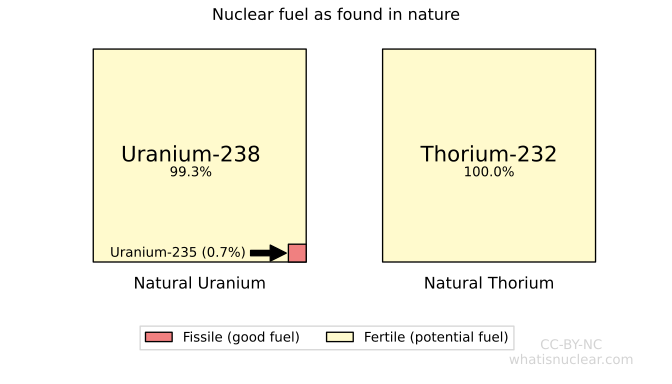
Nuclear fuel used today almost all starts out as natural uranium, which has two isotopes in it, Uranium-238 and Uranium-235. The minority isotope (U-235) can sustain a nuclear chain reaction. We call such isotopes fissile. The other isotopes (U-238 and Thorium-232) are fertile, meaning they could be changed into fissile nuclides in a reactor, but cannot sustain a chain reaction on their own. Natural fuel forms are shown below.
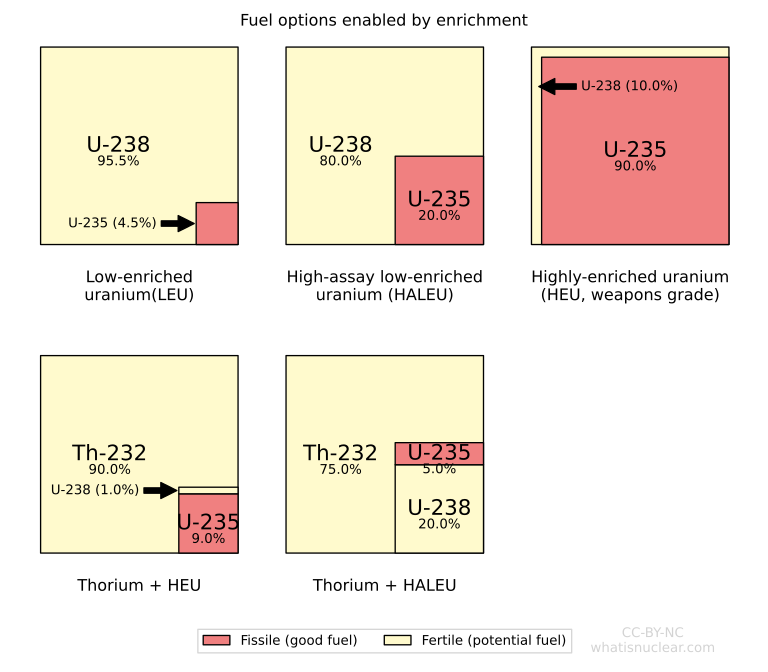
Because it contains some fissile material naturally, it is possible to build a few kinds of nuclear reactors directly fueled with natural uranium. The first man-made nuclear reactors used natural uranium and ultra-pure graphite. Canada’s CANDU reactors use natural uranium with heavy water. But many new benefits arise if you mechanically concentrate the U-235 to a higher fraction. This difficult process is done in uranium enrichment plants. Most power reactors today are fueled with low-enriched uranium. Note that as uranium is enriched more, larger piles of depleted uranium (mostly U-238) are left over as tails. The following figure shows fuel forms enabled by enrichment.
Once the neutron chain reaction begins in a reactor, a number of key things happen to the atoms:
- Most (but not all) of the fissile atoms get split by the neutrons into smaller atoms called fission products, releasing the nuclear energy as heat. As these fission products build up, they eventually absorb lots of neutrons themselves, requiring the reactor to refuel with new fissile atoms.
- Many of the fertile atoms absorb neutrons too, after which:
- Some directly fission into fission products as above
- Some go through a series of nuclear reactions to become fissile nuclides
- Some of these newly-generated fissile atoms get fissioned right away
- Others of the newly-generated fissile atoms remain after the chain reaction stops
When a nucleus has too many neutrons to remain stable, it can undergo a nuclear transformation called beta-decay breaking a neutron into a proton and an electron. The electron (called a beta-particle because it originated in the nucleus) flies off into nature.
When U-238 absorbs a neutron in a reactor, it becomes U-239, the isotope with one extra neutron than U-238. This unstable nuclide beta-decays quickly into Np-239. Then, the Np-239 beta-decays again to become Pu-239, a fissile isotope that can power nuclear reactors. A analogous process happens when Thorium-232 absorbs a neutron to become fissile Uranium-233.
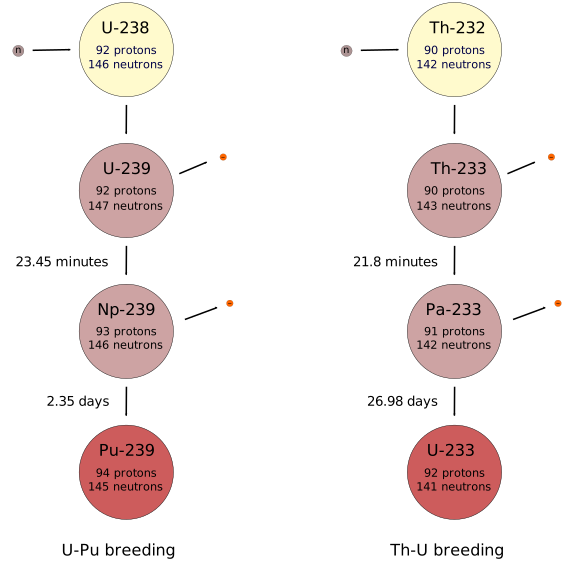
The fissile atoms left over in the used fuel (red in the figure below) are what can be recycled. How many fissile atoms are in the used fuel depends strongly on the kind of reactor used. Typical reactors leave just a little bit, but special reactors called breeder reactors can actually leave more fissile material than they started with!
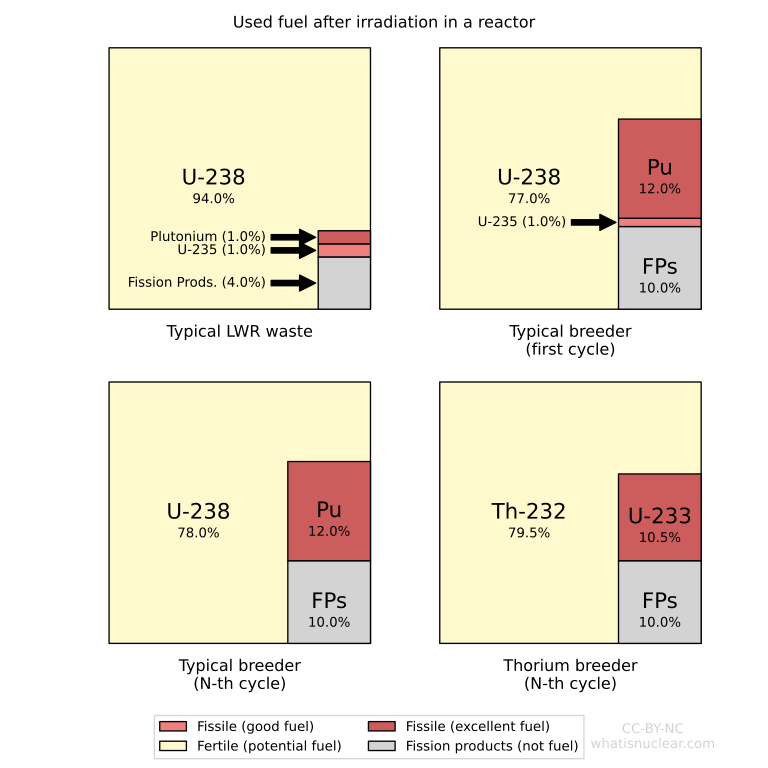
All reactors have some fissile material left over when the fuel is discharged. If you pull this material out and put it into a reprocessing plant you can separate out the constituents and then remix them as desired for your fuel cycle. Recycling has several use cases:
- Sustainability — You can separate the fissile material from the neutron-absorbing fission products and refabricate it into new fuel for another reactor, thereby improving your overall fuel efficiency. This effectively increases the miles-per-gallon of your reactor.
- Radiotoxicity reduction — If you recycle your fuel in fast-neutron reactors, you can transmute the waste nuclides from ones with 10,000-year half-lives to ones with 200-year half-lives, reducing the long-term radiotoxicity of your waste. (See more at the waste page).
- Waste Design — You can change the physical form of your waste into something extra compatible with its ultimate repository, e.g. by vitrifying it, grouting it, and so on.
- Military weapons — The original reprocessing was done to obtain weapons-grade plutonium from natural uranium fueled reactors at Hanford. Other countries have used reprocessing of special weapons-production reactor fuel for similar purposes. Note that this is less of a concern for power reactors because the isotopic composition of the plutonium that remains is not ideal for nuclear weapons.
What is a breeder reactor?
Breeder reactors are nuclear reactors configured to generate more fissile fuel from fertile potential fuel during operation than they consume. The net gain in converting fertile material into fissile material implies that all of the fertile natural resources shown in the first image of this page can be utilized in reactors. Contrast this with non-breeder reactors, which can effectively only use the tiny red box’s worth.
The sustainability implications of breeder reactors are astounding. If you use breeder reactors, nuclear fuel resources can last for billions of years.
The trick to making a breeder reactor comes down to knowing something about nuclear physics. The key facts are:
- When fast neutrons cause a fission, more secondary neutrons are released than if a slow neutron causes fission
- The likelihood of any nuclide capturing a neutron decreases rapidly when the neutron is moving really fast (faster than 1 MeV), but the likelihood of a fast neutron causing fission stays reasonably high.
- U-233 emits more neutrons per fission when split by a slow neutron than U-235 or Pu-239, and has a better capture-to-fission ratio.
The net result of these facts can be summarized with a plot of eta (η), which is the number of neutrons released in fission per neutron absorbed in fuel. When eta is sufficiently higher than 2.0, you can make a breeder reactor. Thus, the options are:
- Make a thorium/U-233 breeder with slow neutrons (left-hand side), or
- Make a uranium/plutonium breeder with fast neutrons (right-hand side)
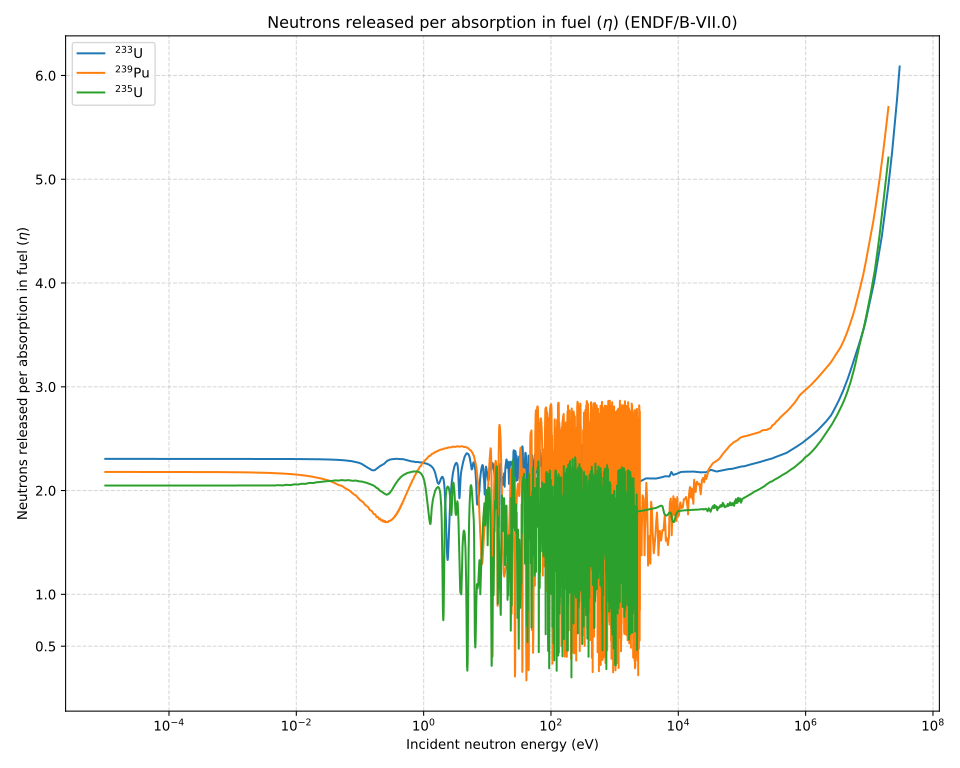
Both of these configurations have sufficient excess neutrons to allow you to pack in lots of fertile material while still sustaining a nuclear chain reaction. The more fertile material you pack in, the more neutrons get invested in it, generating fissile material.
Note: You can read more about fast reactors and thorium reactors. Note that all thorium are necessarily breeder reactors, since natural thorium has no fissile component.
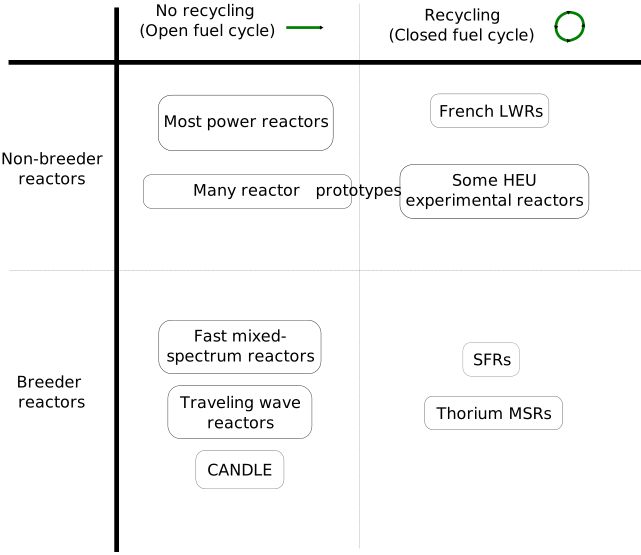
Recycling and breeding are often thought of together, but they are on separate axes. Countries like France recycle fuel from non-breeder reactors. Most long-term sustainable nuclear plans involve using breeder reactors plus recycling. It is also possible to use a breeder reactor without recycling at all using advanced deep-burn fuels.
Challenges in Recycling Nuclear Waste
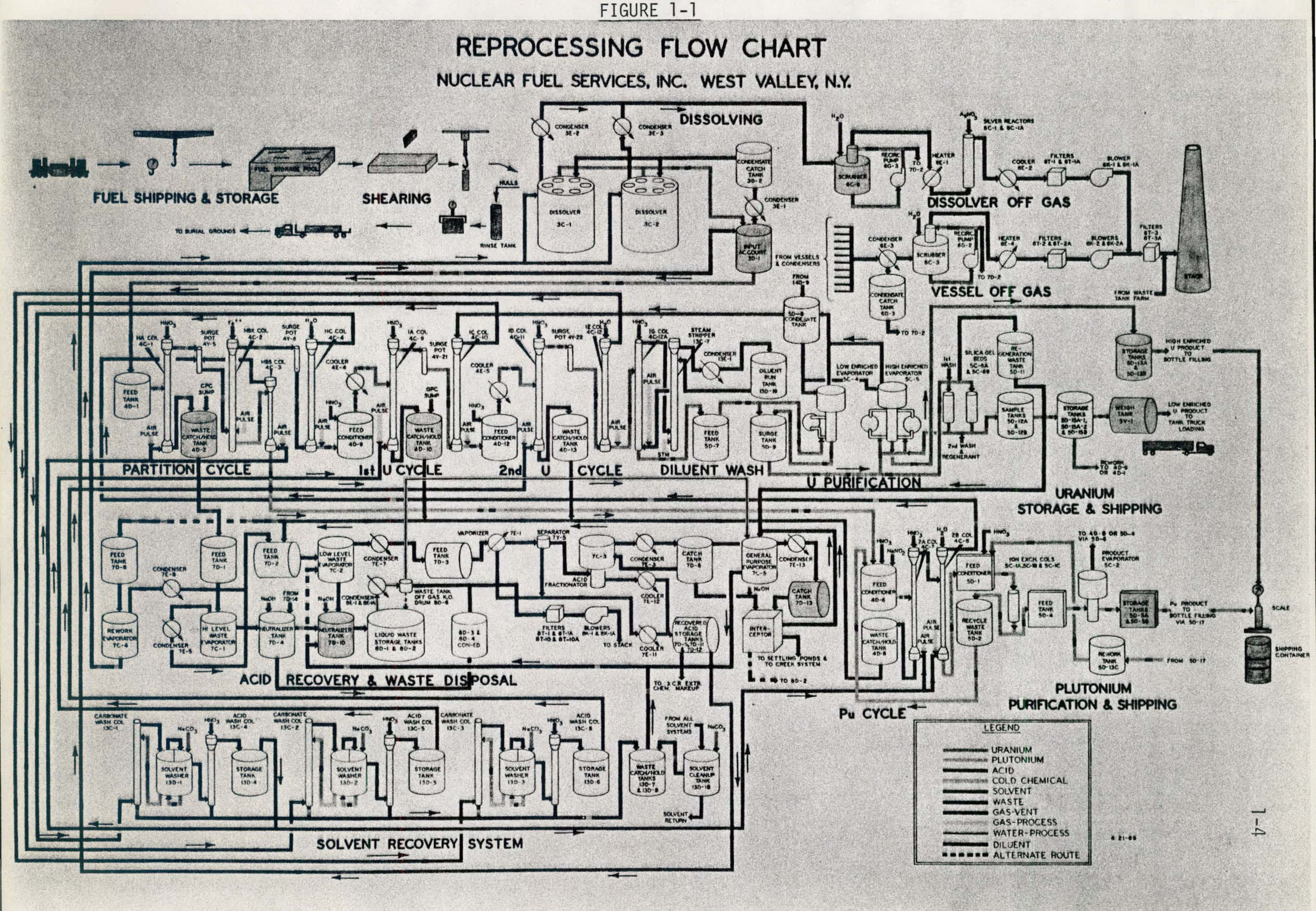
The primary reason most nuclear operators do not recycle their waste is that recycling irradiated nuclear fuel is complex and expensive. Spent fuel is intensely radioactive and contains elements covering nearly 50% of the periodic table. All unit operations must be done remotely through thick shielded walls. If something breaks, maintenance has to be done remotely as well. Besides radioactivity, recycling facilities must also avoid neutron chain reaction criticality, meaning care must be taken to avoid concentrating fissile material or assembling it into too large of a spherical shape. An example flow chart from an aqueous reprocessing plant is shown below. Simpler processes are possible, but this gives a rough understanding of the complexities.
Furthermore, proliferation challenges are involved in reprocessing. President Jimmy Carter outlawed commercial recycling in the USA in 1977, but his successor, President Ronald Reagan unbanned it in 1981, and it has remained legal ever since (missing reference).
Studies have suggested that the economics of reprocessing will only be better than the cost of once-through fuel cycles after uranium prices exceed $360/kg (Bunn & \noopsortzwaanvan der Zwaan, 2003).
Nuclear Fuel cycles
A nuclear fuel cycle is the path that nuclear fuel (Uranium, Thorium, Plutonium, etc.) takes as it is used to generate power in a nuclear reactor. Our fuel cycle page has more info. They describe where the material comes from and where it ends up. Different fuel cycles range from very simple to fairly complicated. We describe several of these below.
Once-Through Fuel Cycle
Figure 1. A once-through fuel cycle. Hover for more info.
The simplest fuel cycle is the once-through cycle. It is the de-facto standard in most operating nuclear power plants, with a few exceptions in Europe and Asia. Uranium is mined, enriched, used in a reactor (where it becomes radioactive nuclear waste), and then stored until it is no longer dangerously radioactive. While this cycle is cheap, there are two major problems with it. Firstly, the waste is radioactive for hundreds of thousands of years. No one has been able to design a repository that is convincingly capable of storing material for that long. Secondly, Uranium is not the most abundant element on Earth, and in this kind of cycle, the global supply of cheap uranium could run low within 200 years. So much for sustainability! There are some deep-burn once-through cycles out there that have good sustainability properties though.
Closed Fuel Cycle
Figure 2. A closed fuel cycle. Here nuclear material is recycled.
Closing the fuel cycle involves recycling the nuclear waste as new fuel. Since the main component of nuclear waste is Uranium-238 (which can be transmuted to Plutonium, especially with advanced breeder reactors), we can get more energy out of the waste than in a once-through cycle (see factoid 2 to see how much). The recycling plant separates the good stuff from the bad stuff. The bad stuff is mostly fission products, the atoms that a Uranium atom becomes after it splits in the fission process. These fission products mostly decay to safe levels within 300-500 years, which is significantly shorter than standard nuclear waste. So, by closing the fuel cycle with standard reactors, we address the issue of nuclear waste identified in the once-through cycle. In this case, nuclear waste is a tractable problem. But most of the reactivity is coming from the mine, since standard reactors burn most of the fissile nuclide, U-235. Also, the reprocessing technology is expensive and separates out pure Plutonium, which could possibly be stolen, bringing a rogue entity closer to having a nuclear weapon. For these reasons, the USA does not currently recycle. There are ways to solve these issues.
Breeder Fuel Cycle
Figure 3. A closed fuel cycle with breeding. More fissile material is created from breeding than is used to make energy. Hover over images for more info.
Breeder reactors can create as much or more fissile material (atoms that readily split) than they use. These special reactors are designed to have extra neutrons flying around, so that some can convert U-238 to Pu-239 (see above) and the others can run the reactor. Often, these special reactors are deemed "fast" reactors because the neutrons are moving through the reactor at higher speeds, on average. In a full breeder fuel cycle, we get the maximum use of the Uranium resources on Earth, and what we already know exists can last tens of thousands of years. The cycle has cost and proliferation concerns associated with any closed cycle. Additionally, we have significantly less operational experience with breeder reactors, so we would need to train builders and operators for such a machine. Using a Thorium cycle instead of a Uranium-Plutonium cycle may allow breeding in less exotic reactors. Using this kind of fuel cycle, nuclear power can truly be considered sustainable.
Questions? Send them in!
References
- Johnson, A. I. (1978). Final Report, Task 3: Possible Uses of the Nuclear Fuel Services, Inc. Reprocessing Plant at West Valley, New York. [For Research on Alternative Fuel Cycles, Spiking, Coprocessing, Waste Solidification, and Recovery of Radioactive Gases] (No. ANL-K-78-4190-3; Issue ANL-K-78-4190-3). Johnson (E.R.) Associates, Inc., Vienna, VA (USA). https://doi.org/10.2172/6499393
- Bunn, M., & \noopsortzwaanvan der Zwaan, B. (2003). The Economics of Reprocessing Versus Direct Disposal of Spent Nuclear Fuel. Belfer Center for Science and International Affairs, Harvard University. https://dash.harvard.edu/handle/1/30209100
Additional Reading
- Implications of Partitioning and Transmutation in Radioactive Waste Management, IAEA Technical Reports Series 435
- Principles of Fast, Thermal, and Breeder reactors – And old but useful video about this information
- Our fuel cycle page
- Our explanation of enrichment
- Our nuclear waste page
- Our Breeder reactors page
- Yucca Mountain (Wikipedia)
- Our Moderation page