What is thorium?

By Dr. Nick Touran, Ph.D., P.E., 2012-02-19, Updated 2024-06-02, Reading time: 8 minutes
 Thorium is a basic element of nature, like Iron and Uranium. Like Uranium, its properties allow it
to be used to fuel a nuclear chain reaction that can run a power plant and make electricity (among
other things). Thorium itself will not split and release energy. Rather, when it is exposed to
neutrons, it will undergo a series of nuclear reactions until it eventually emerges as an isotope of
uranium called U-233, which will readily split and release energy next time it absorbs a neutron.
Thorium is therefore called fertile, whereas U-233 is called fissile.
Thorium is a basic element of nature, like Iron and Uranium. Like Uranium, its properties allow it
to be used to fuel a nuclear chain reaction that can run a power plant and make electricity (among
other things). Thorium itself will not split and release energy. Rather, when it is exposed to
neutrons, it will undergo a series of nuclear reactions until it eventually emerges as an isotope of
uranium called U-233, which will readily split and release energy next time it absorbs a neutron.
Thorium is therefore called fertile, whereas U-233 is called fissile.
Reactors that use thorium are operating on what’s called the Thorium-Uranium (Th-U) fuel cycle. The vast majority of existing or proposed nuclear reactors, however, use enriched uranium (U-235) or reprocessed plutonium (Pu-239) as fuel (in the Uranium-Plutonium cycle), and only a handful have used thorium. Current and exotic designs can theoretically accommodate thorium.
The Th-U fuel cycle has some intriguing capabilities over the traditional U-Pu cycle. Of course, it has downsides as well. On this page you’ll learn some details about these and leave with the ability to productively discuss and debate thorium with knowledge of the basics.
Up and coming nuclear reactor powerhouses China and India both have substantial reserves of Thorium-bearing minerals and not as much Uranium. So, expect this energy source to become a big deal in the not-too-distant future…
Hype alert If someone on the internet told you something unbelievable about Thorium, you might want to check out our Thorium Myths page just to double check it.
On this page
What are the key benefits of Thorium?
-
Thorium cycles uniquely allow slow-neutron breeder reactors (as opposed to uranium cycles, which can only breed with fast neutrons). This means that if the fuel is reprocessed, reactors could be fueled without mining any additional U-235 for reactivity boosts, which means the nuclear fuel resources on Earth can be extended by at least 2 orders of magnitude without some of the complications of fast reactors.
-
The Th-U fuel cycle does not irradiate Uranium-238 and therefore does not produce transuranic (bigger than uranium) atoms like Plutonium, Americium, Curium, etc. These transuranics are the major health concern of long-term nuclear waste. Thus, Th-U waste will be less toxic on the 10,000+ year time scale.
Are there any additional benefits of Thorium?
- Thorium is more abundant in Earth’s crust than Uranium, at a concentration of 0.0006% vs. 0.00018% for Uranium (factor of 3.3x). This is often cited as a key benefit, but if you look at the known reserves of economically extractable Thorium vs. Uranium [1,2], you’ll find that they are both nearly identical. Also, substantial Uranium is found dissolved in sea-water, whereas there is 86,000x less Thorium in there. If closed fuel cycles or breeding ever become mainstream, this benefit will be irrelevant because both the Th-U and the U-Pu fuel cycles will last us well into the tens of thousands of years, which is about as long as modern history.
What are the downsides of Thorium?
-
We don’t have as much experience with Th. The nuclear industry is quite conservative, and the biggest problem with Thorium is that we are lacking in operational experience with it. When money is at stake, it’s difficult to get people to change from the norm.
-
Thorium fuel is a bit harder to prepare. Thorium dioxide melts at 550 degrees higher temperatures than traditional Uranium dioxide, so very high temperatures are required to produce high-quality solid fuel. Additionally, Th is quite inert, making it difficult to chemically process. This is irrelevant for fluid-fueled reactors discussed below.
-
Irradiated Thorium is more dangerously radioactive in the short term. The Th-U cycle invariably produces some U-232, which decays to Tl-208, which has a 2.6 MeV gamma ray decay mode. Bi-212 also causes problems. These gamma rays are very hard to shield, requiring more expensive spent fuel handling and/or reprocessing.
-
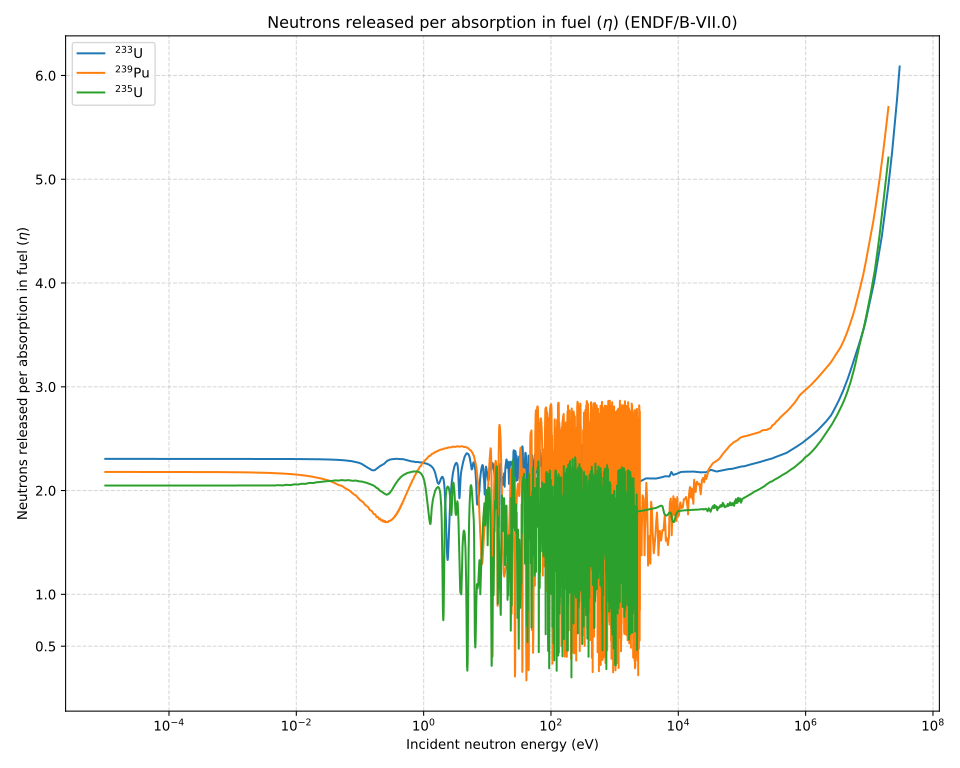
Thorium doesn’t work as well as U-Pu in a fast reactor. While U-233 an excellent fuel in the slow-neutron regime, it is between U-235 and Pu-239 in the fast spectrum (see this plot showing neutrons released per neutron absorbed in fuel). So, the breeding doubling time is slower for thorium cycles than for uranium-plutonium cycles in fast reactors. Additionally, Thorium cycles are not ideal in reactors that require excellent neutron economy (such as breed-and-burn concepts).
Proliferation Issues
Thorium is generally accepted as proliferation resistant compared to U-Pu cycles. The problem with plutonium is that it can be chemically separated from the waste and perhaps used in bombs. It is publicly known that even reactor-grade plutonium can be made into a bomb if done carefully. By avoiding plutonium altogether, thorium cycles are superior in this regard.
Besides avoiding plutonium, Thorium has additional self-protection from the hard gamma rays emitted due to U-232 as discussed above. This makes stealing Thorium based fuels more challenging. Also, the heat from these gammas makes weapon fabrication difficult, as it is hard to keep the weapon pit from melting due to its own heat. Note, however, that the gammas come from the decay chain of U-232, not from U-232 itself. This means that the contaminants could be chemically separated and the material would be much easier to work with. U-232 has a 70 year half-life so it takes a long time for these gammas to come back.
The one hypothetical proliferation concern with Thorium fuel though, is that the Protactinium can be chemically separated shortly after it is produced and removed from the neutron flux (the path to U-233 is Th-232 → Th-233 → Pa-233 → U-233). Then, it will decay directly to pure U-233. By this challenging route, one could obtain weapons material. But Pa-233 has a 27 day half-life, so once the material has been guarded for a few times this and then mixed in with the less pure fuel mix, weapons material would be much harder to produce. So concerns over people stealing spent fuel are largely reduced by Th, but the possibility of the owner of a Th-U reactor obtaining bomb material is not.
Molten Salt Reactors
Update: See our full page on Molten Salt Reactors for more info.
One especially cool possibility suitable for the slow-neutron breeding capability of the Th-U fuel cycle is the molten salt reactor (MSR), or as one particular MSR is commonly known on the internet, the Liquid Fluoride Thorium Reactors (LFTR). In these, fuel is not cast into pellets, but is rather dissolved in a vat of liquid salt. The chain reaction heats the salt, which naturally convects through a heat exchanger to bring the heat out to a turbine and make electricity. Online chemical processing removes fission product neutron poisons and allows online refueling (eliminating the need to shut down for fuel management, etc.). None of these reactors operate today, but Oak Ridge had a test reactor of this type in the 1960s called the Molten Salt Reactor Experiment [wikipedia] (MSRE). The MSRE successfully proved that the concept has merit and can be operated for extended amounts of time. It competed with the liquid metal cooled fast breeder reactors (LMFBRs) for federal funding and lost out. Alvin Weinberg discusses the history of this project in much detail in his autobiography, The First Nuclear Era [amazon.com], and there is more info available all over the internet. These reactors could be extremely safe, proliferation resistant, resource efficient, environmentally superior (to traditional nukes, as well as to fossil fuel obviously), and maybe even cheap. Exotic, but successfully tested. Who’s going to start the startup on these? (Just kidding, there are already like 4 startups working on them, and China is developing them as well).
See Also
- Our Thorium Myths page
- Our breeding and recycling page
- Our molten salt reactor page
- IAEA TECDOC-1450 Thorium fuel cycle - potential benefits and challenges. 113 pages of professional information.
- Energy From Thorium - a site dedicated to potentially excellent uses of Thorium in LFTRs
- Thorium fuel cycle [wikipedia]
- Molten Salt Reactor Experiment [wikipedia]
- The First Nuclear Era [amazon.com]
- Nuclear Power is our gateway to a prosperous future - An Op-Ed by A.P.J. Abdul Kalam, a former president of India
- Liquid Fluoride Thorium Reactor [wikipedia]
- Special May 2016 Edition of Nuclear Technology on Thorium
References
Questions? Comments? Send us a note.